01
Contextual intelligence
Students discover that requirements, users, infrastructure and acceptable solutions vary between places.
Cross-border student collaboration
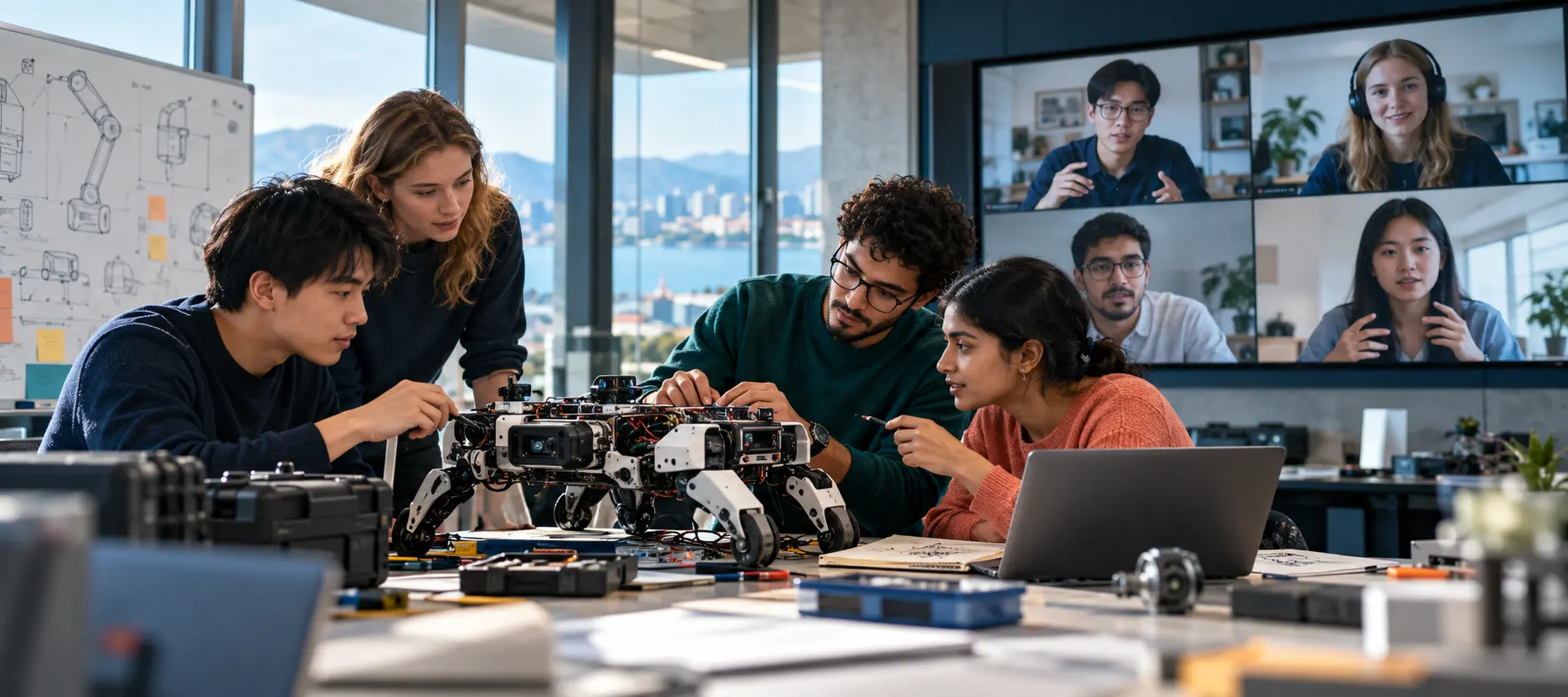
CIRC structures international AI and robotics teams around shared briefs, clear roles, supervised communication and compatible technical workflows. The model is suitable for secondary and high-school learners and can connect two schools or a wider network while respecting safeguarding, language, timetable and technology constraints.
Structured team formation
Distributed projects
Supervised collaboration
Joint technical outputs
01 / Why international teams
01
Students discover that requirements, users, infrastructure and acceptable solutions vary between places.
02
Teams practise interfaces, documentation, version control and handover because collaborators cannot rely on being in the same room.
03
Learners clarify terminology, listen actively, manage disagreement and avoid treating one perspective as universal.
04
A joint outcome depends on reliable individual contributions, transparent progress and early communication of problems.
02 / Team formation
School readiness
Partners compare age range, calendar, curriculum, language support, devices, teacher time, technical resources and communication policies.
Student profile
A short, non-exclusive profile helps distribute coding, engineering, research, design and communication strengths.
Team charter
Students define roles, meeting rhythm, response expectations, decision rules, file organisation and respectful conduct.
Shared baseline
An induction aligns terminology, technical tools, responsible-AI expectations and the project’s assessment criteria.
03 / Distributed team roles
01
Maintains the user need, local evidence, requirements and shared project priorities.
02
Defines components, interfaces, data formats and the process for combining work from different locations.
03
Builds software, robotics or analysis modules and supplies reproducible documentation and test evidence.
04
Coordinates verification, issues, meeting records, translation checks and the joint demonstration.
04 / Feasible collaboration model
01
Each local team shares a concise approved update: completed work, evidence, decisions, risks and requests.
02
Versioned files, task boards and agreed naming conventions reduce confusion and make contributions traceable.
03
Teacher-supervised live sessions focus on requirements, design review, integration, testing and final rehearsal rather than routine status.
04
Plain language, glossaries, diagrams, captions and reviewed translations support understanding without hiding uncertainty.
05 / Project model
Partner teams deploy comparable sensors or work with aligned datasets to investigate a local environmental condition, then build a shared dashboard or comparative evidence report.
01
Schools agree variables, units, sampling frequency, quality checks and metadata needed for interpretation.
02
Teams explain environmental context and investigate patterns without transferring unnecessary personal or sensitive information.
03
Students co-design a dashboard, map or briefing that preserves differences instead of combining incompatible data uncritically.
04
The final review identifies supported findings, unresolved questions and improvements for a future data cycle.
06 / Project model
Schools develop compatible modules or contextual variants for one robotics mission. Physical integration can occur through shared specifications, simulation or a final hosted event.
01
Teams agree commands, data messages, dimensions, test inputs or simulation conditions before building independently.
02
Partners may specialise in navigation, perception, payload, user interface, mapping or mission planning.
03
One team verifies another team’s module, documentation or test results using a defined acceptance procedure.
04
The programme concludes with remote simulation, exchanged test recordings or supervised physical integration and review.
07 / Project model
Students create an application or information service for users in more than one language, using AI only where it adds justified value.
01
Each partner contributes local user scenarios and identifies meanings or expectations that may not translate directly.
02
Teams may prototype search, summarisation or translation but establish human verification for important information.
03
Navigation, reading level, layout, captions and device constraints are tested across participating contexts.
04
Students document sources, permissions, known errors, moderation needs and what would be required for real public use.
08 / Team governance
01
Communication uses agreed institutional systems, named staff oversight and clear limits on private contact.
02
Schools define participation, media permissions, student identification, recording, storage, access and deletion.
03
Students know how to report absence, inappropriate communication, technical risk, conflict or inability to complete a commitment.
04
Teams record authorship, licences, external materials, mentor support and AI-assisted work transparently.
09 / Assessment
01
Quality, completeness and reproducibility of the student’s owned module or analytical work.
02
Use of interfaces, documentation, feedback and testing to make separately developed work function together.
03
Reliability, communication, decision-making, response to conflict and support for collective progress.
04
Evidence that the student recognised contextual difference, checked assumptions and adapted communication or design.
10 / Programme formats
4–6 weeks
Local investigations and two structured exchanges lead to a shared presentation or evidence board.
8–12 weeks
International teams follow common milestones and create one integrated technical or research output.
Two terms
Induction, co-design, distributed build, cross-testing and final showcase support deeper team development.
Annual
Returning schools develop student leaders, teacher coordinators and progressively more advanced shared briefs.
Build the next programme
We can shape a class project, school pilot, international team or multi-school pathway around your learners.